Borówka South
Borówka South
One of the major issues with practicing astronomy in Poland is the weather. It is generally poor with maybe 60 observational nights per year, with the cloud cover being primary problem factor. Another concern is the unpredictability. While we typically have good weather in the spring and summer and sometimes in the winter, if it’s cold, but in recent years it wasn’t. This is particularly bad for certain types of observing activity that requires long series of observations, preferably multi-night, in particular asteroid tracking and search and variable stars observing.
Due to those reasons I decided to start looking for a better place to a place with better weather and conditions.
The more the merrier
One of the pivotal aspects of this initiative was meeting with Kamil Fiedosiuk, a like-minded well accomplished astronomer who had his own observatory nearby and was struggling with the same weather problems. After many discussions, we decided that it’s time to look for a dark site.
Selection criteria
There are some pretty obvious astronomical aspects to consider. You want to pick a site that offers dark skies and good weather around the year.
Picking the right site depends on the requirements. For some, price is the deciding factor. But opting for the absolute cheapest might be a poor strategy as there are many additional factors than simple monthly or yearly fee.
The hardware that’s usually bulky needs to be shipped and installed. Sometimes the installation is included if you pay for whole year up front, but often there’s some installation fee involved. It’s worth asking if it’s a flat fee or charged per hour.
Properly packaged scope is usually bulky, the mount and counterweights are heavy. For example, the shipping boxes with full Takahashi Epsilon 180ED, with the mount and accessoried weighted 54kg. And that was without the counterweights. Which brings me to another topic - counterweights are simple, but heavy. Often times, it’s cheaper to manufature or buy them locally. You probably want to ask before shipping your 30kg of steel to the other side of the planet.
The hosting observatory is often in a different jurisdiction. The shipment might require paying extra customs, duty fees, taxes and similar on top of the expected shipping fees. Often a shipping agent is involved, which incurs extra fees, but makes the process smoother.
Some hostings offer to set up the hardware, so travelling on day 1 might not be necessary, but sooner or later you’ll want to visit and do some maintenance or just experience the truly dark site yourself. It is helpful if it’s reasonably easy to travel to the observatory. Flight prices or possible extra difficulties (such as visas) might be a factor in some cases.
You will need to be in contact with the hosting team. Ask them some questions and see how quickly or slowly they will be with the responses and how detailed or brief their response will be.
Typically, your setup will start producing massive amounts of data. For example, our scope uses ASI6200 MM Pro camera. A single sub weighs 122MB. Assuming 3 minute subs, and a coservative 8 hours a night, that’s 20GB per night. That’s 600GB per month. Every month. When shipping your setup, please consider appropriate disk size. Also, think about your processing pipeline. Downloading this amount of data is untenable in most cases. Some data reduction on site is usually necessary. That’s what we’re doing right now - subframes are reviewed, registered and stacked locally and we only download the stacks.
There is another fuzzy parameter, which is hard to realistically estimate: horizon exposure. You want your pier to be as tall as possible, to get access to objects on low altitudes. On the other hand, your setup needs to be sufficiently low, so it doesn’t hit the roof. Some people opt to have shorter pier, so there’s no collision with the roof, no matter the scope orientation. This gives you a peace of mind, but you pay for it with limited sky access.
Finally, there’s the aspect of access to part of the sky that you don’t have to from your home location. Author of this text lives in northern part of Poland, so in my case that meant lack of access to southern sky. As such, any potential sites with access to southern skies were getting extra points.
Hosting options
There are many remote telescope farms. During the process, we tried to make a list of them. This possibly might be of use to others looking for remote options. Here they are. Unless otherwise notes, the information was more or less up to date as of late 2025.
There are many hostings in Spain: AstroCamp, Trevinca, Otivar, E-eye, PixelSkies, RoboScopes and probably more. They offer great conditions, compared to Poland. Some of them publish historical data. The best data available was from AstroCamp in Nerpio, which claim to have 270 observational nights.
On the nothern hemisphere, an appealing option is StarFront in Texas. They have two serious benefits - located in US, so hardware could be bought in US and shipped directly without EU import duties and expensive intercontinental shipping. Also, they are reasonably priced. The mini pier starts at 150USD/month, with even cheaper options for smart telescopes.
The downside is that all of their sheds are massing with literally hundreds of telescopes on site. If you do have special needs for your setup, they might be less likely to accommodate. Also, while they’re closer to equator compared to Poland, their exposure to the sourthern sky is somewhat limited.
Then there are some more options worth comparing:
| Hosting name | Location | Lattitude | Longitude | Altitude [m] | Link | Price/month [EUR] | SQM | Clear nights/year |
|---|---|---|---|---|---|---|---|---|
| Borówka | Czarne, PL | 53,844 | 120 | borowka.space | 0 | 21.3/Bortle 4 | 60 (est.) | |
| Trevinca | ES | 42,242 | 11,602 | 1254 | trevincaskies.com | 140 | 21,6 | 183 |
| Astrocamp | Nerpio, ES | 33,732 | 20,112 | 1650 | astrocamp.es | 270 | ||
| Otivar | ES | 36,828 | 17,016 | 800 | otivarobservatory | 333 | ||
| Starfront | Texas, US | 31,548 | 22,296 | starfront.space | 150+ | 220 | ||
| Hakos | Namibia | -23,231 | 16,360 | 1830 | hakos-astrofarm.com | 333 | ||
| Tivoli | Namibia | -23,461 | 18,015 | tivoli-astrofarm.de | ||||
| E-eye | ES | 38,218 | -6,631 | 560 | e-eye.es | 250–270 | ||
| PixelSkies | ES | 37,719 | -2,641 | 850 | pixelskiesastro.com | 360 | 21,8 | |
| Roboscopes | ES | 38,218 | -6,631 | 560 | roboscopes.com | 21,5 | ||
| DSP Remote | New Mexico, US | 32,12 | -108,97 | 1292 | deepspaceproducts.com | 300 USD | 21,7 | |
| Obs Tech | Hurtado Valley, Chile | obstech.cl | 875 | |||||
| Cosmoescape | 630, 1423 | cosmoescape.com | 21,6 | 219 | ||||
| Chilescope | chilescope.com |
Hakos
For us, we decided to take a closer look at Hakos. We reached out and very soon got a very detailed answers to our questions. Some follow-up dicussions ensued and soon enough we were chatting on WhatsApp, with the Hakos staff being extremely quick in responding. This was a very welcome change, compared to disappointing older experience with AstroCamp many years ago, where contact was only over mail with responses coming up after couple days.
The site has pristine dark sky: Bortle 1, with around 220 observing nights. It has access to full southern sky, while being close to the equator, so many of the nothern sky objects are accessible.
Namibia still has strong ties with Germany, with frequent flights with Lufthansa and other airlines. This is very useful as Poland has great connections to Germany. A minor extra benefit is that Namibia is in the same timezone, so it’s easier with the daily routine - we plan the schedule and in evenings and check up the results in the mornings.
The were some gossips about them building a new series of observatories. We reached out and soon enough we got one of the boxes reserved.
Shipping
Juergen Obstfelder from Hakos suggested contacting Claudia Suren from TradeLog. This was an excellent recommendation. She is located in Windhoek, where all international flights and shipments arrive. She also handled many earlier astronomical gear shipments to Hakos, so she knows the drill well. She hired a local shipping and customs agent in Poland, who coordinated the pickup and helped with the customs declaration. Oddly enough, it was more paperwork for the packages to clear customs in Poland, despite there was no duties to be paid in Poland. Just pure beaurecracy. On the Namibian side, it was super straight forward, although expensive. We had to pay 15% import VAT of the declared value. The cargo was delivered from Gdansk to Warsaw by truck, then by Air Ethiopia Cargo to Windhoek, Namibia via Addis Abebba, Ethiopia. And finally, Juergen picked up the parcels in Windhoek and drove to Hakos with his truck. The scope arrived without any damage.
The total price for all the shipping, customs, VAT and plethora of additional taxes was 2130 EUR for 3 boxes of total weight 54kg. Not cheap, but part of the expenses was for a piece of mind. Overall, I think it was well worth it.
Installation
This is how the setup looked after completing all tests in Borówka:
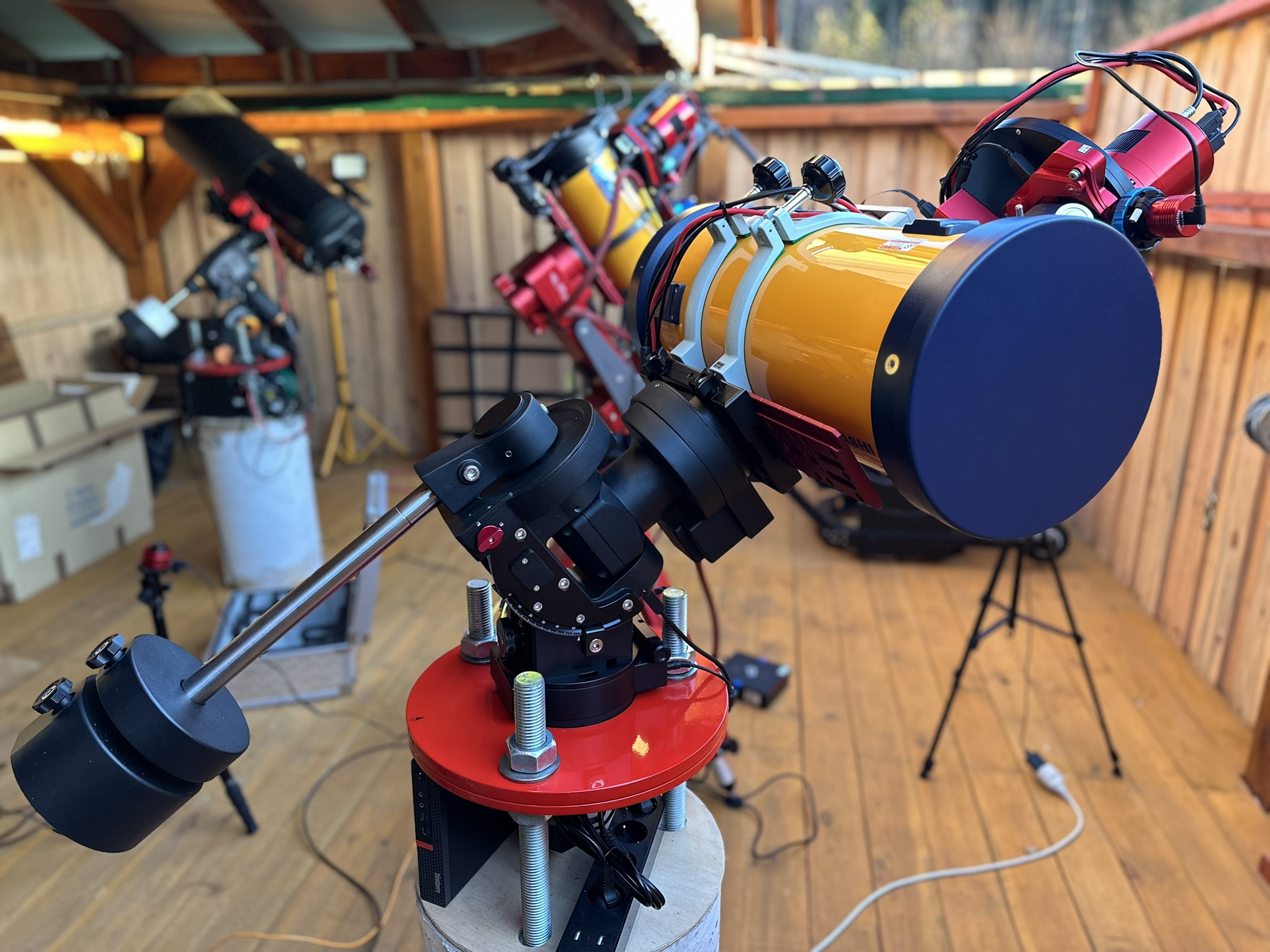
The setup was packed into 3 separate boxes: the telescope into the original triple nested cardboard box, the orginal from Takahashi. If it was good for shipping from Japan to Poland, it should be good for another intercontinental flight. The mount went in its original aluminium suitcase from iOptron. Packaging the camera train was tricky, due to its uncommon shape. The camera itself was round, but it was attached to a large PegasusAstro filter wheel (7 slots for 2" filters makes the wheel really large), followed by trapezoid shaped electronic tilter. I’ve packaged this whole train into rugged DeWalt hardcase, typically used for tools and being able to survive the usual abuse at construction sites. A friend told me one can stand of such base and it sounds believable. The hardcase was filled with a hard foam cut to the shape.
The box is 2.8m by 2.8m. The Hakos team prepared piers to our sepcification. That’s how it looked before our gear arrived. The shipping packages are seen in the background - carboard with a telescope, suitcase with mount and the hardcase with the camera train.
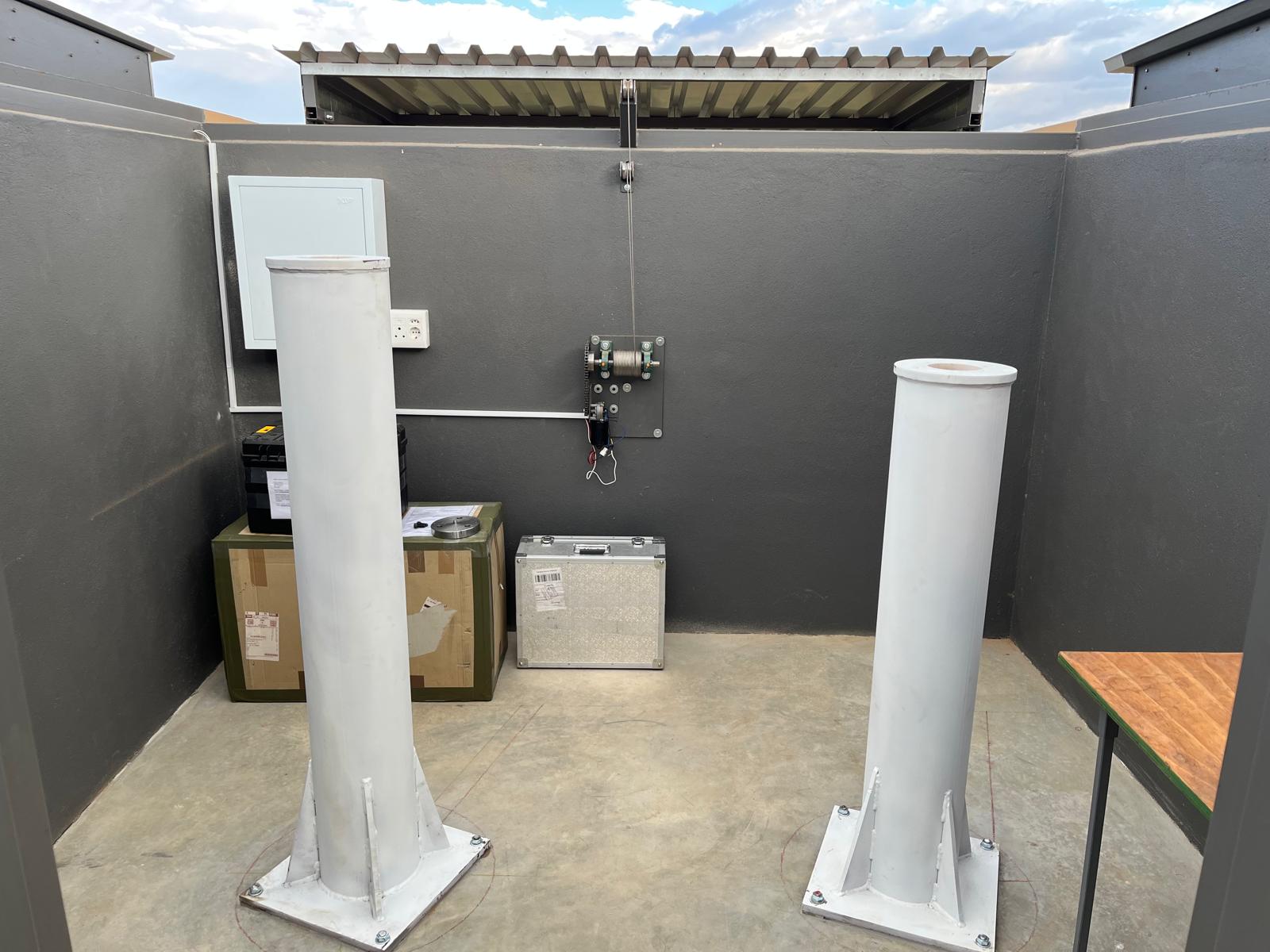
The lower one on the right is for Epsilon 180ED on iOptron CEM70-EC2 mount (“Tomek’s scope”). The taller pier is for Epsilon 130ED on Avalon M-Due mount (“Kamil’s scope”).
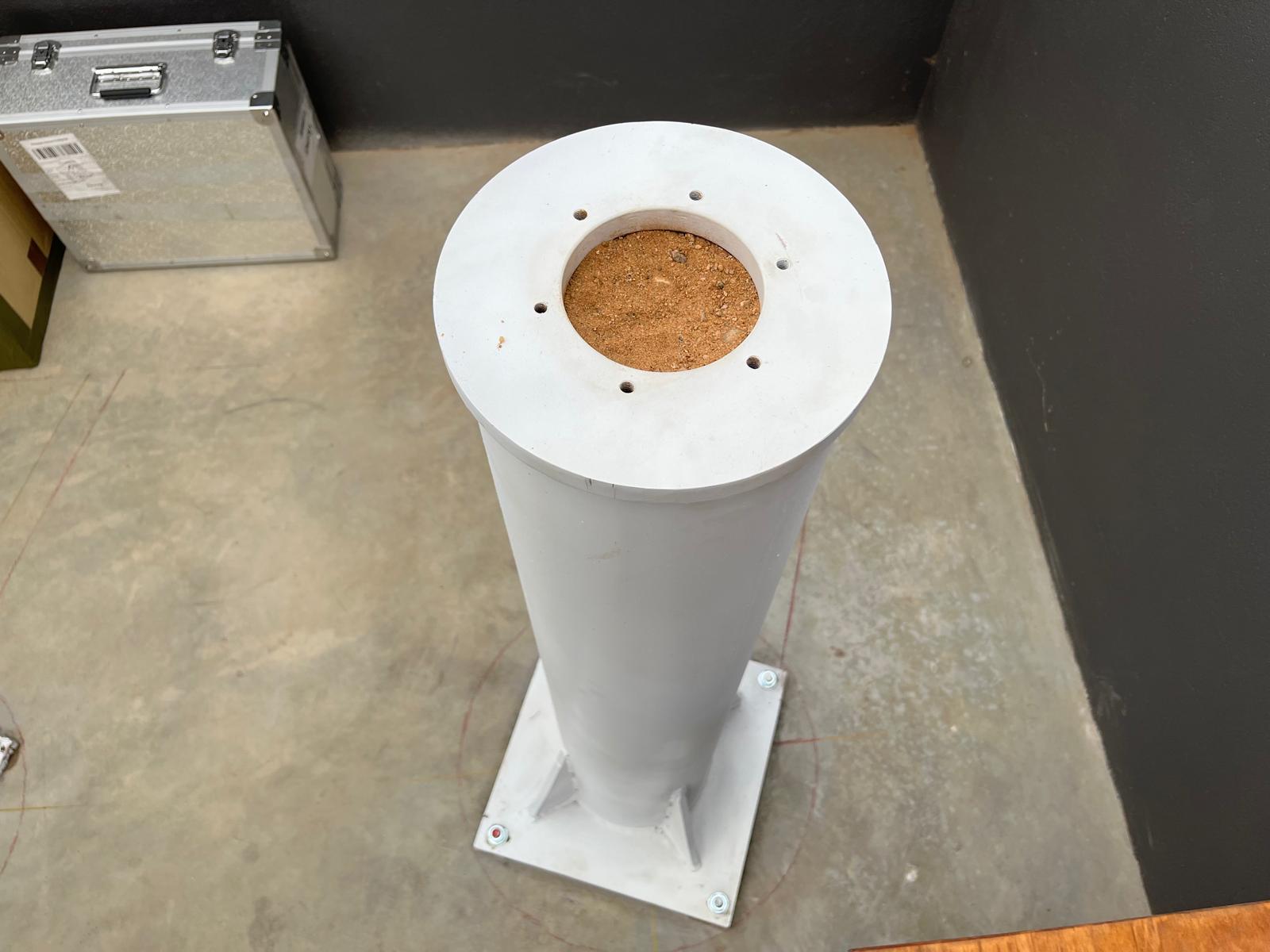
Although we provided the functional specs (the mount plate and height), all the design and machining was arranged by Juergen. Here’s how the pier looks like. It is hollow steel pipe, filled with sand to dampen vibrations. This is a very nice design. Borówka has all concrete piers so far, but the next one might actually be following this design.
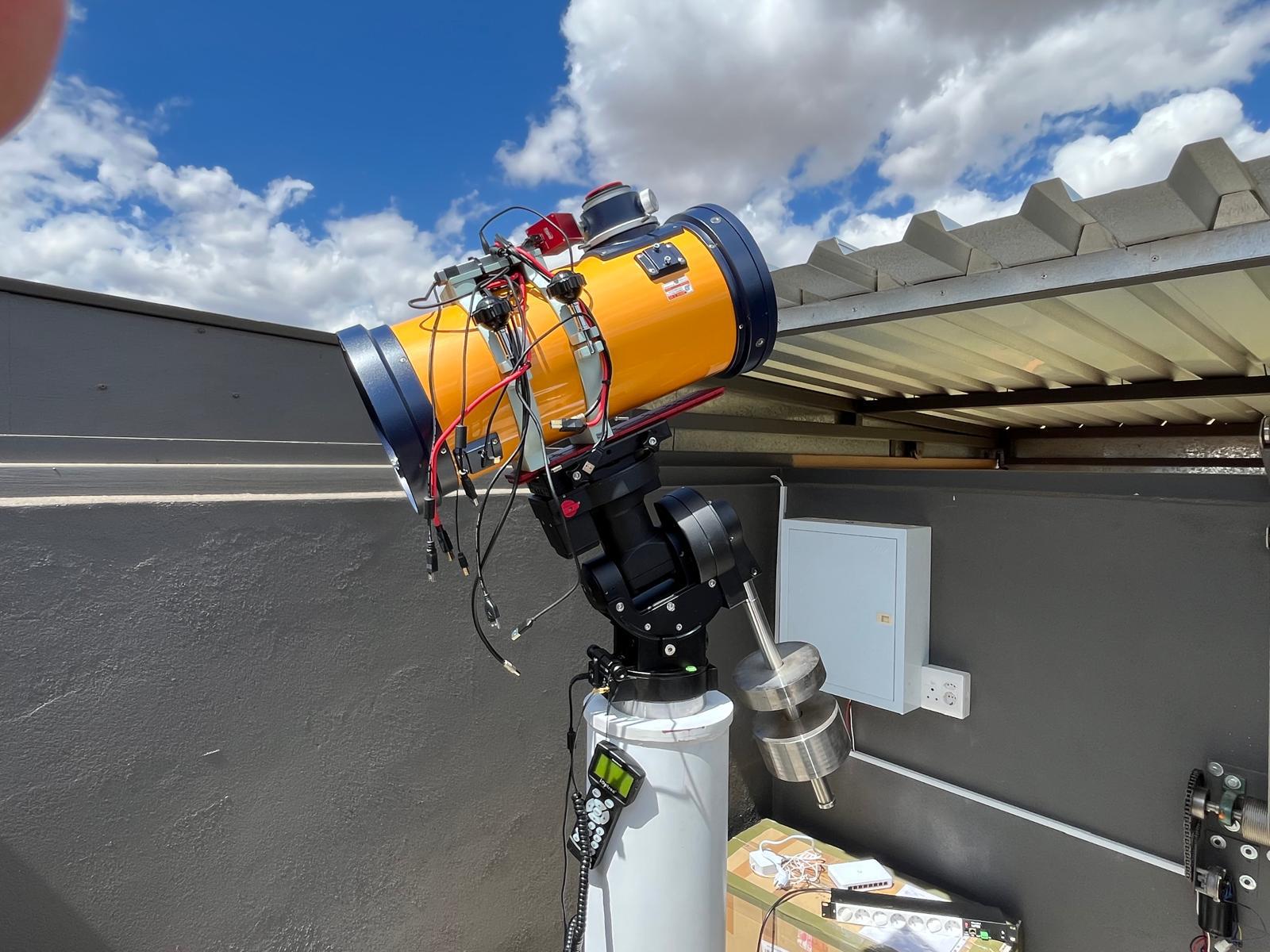
This is how the site looked after mount and scope were installed. Note it’s still missing the the camera train.
We intially planned to ship both scopes together, but sadly due to last moment hardware failure, Kamil’s mount had to be shipped to Avalong service. As a side effect, some of the additional gear that we planned to ship in Kamil’s boxes did not arrive. One of the missing items was a camera. Juergen was very kind to lend us one of his cameras. This is very convenient to be able to see what’s going on with the scope. Here’s how it looks like:
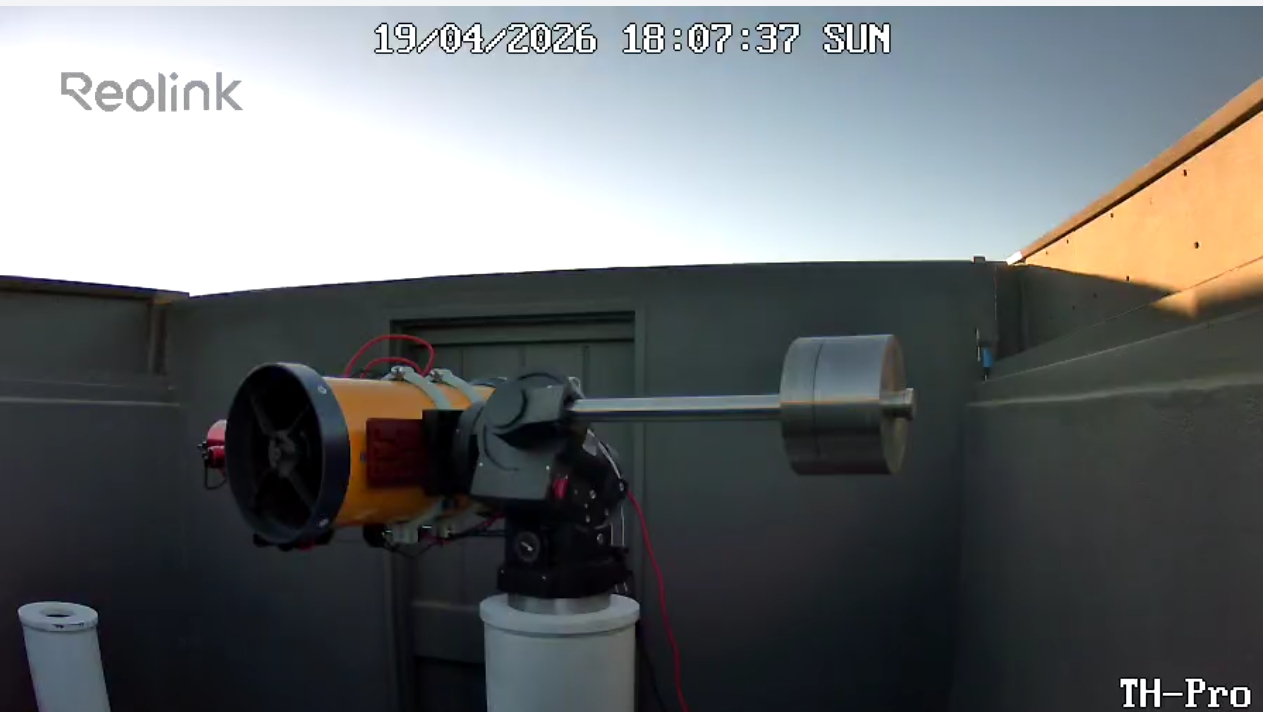
Overall, the shipping was stressful episode, but much of that stress was coming from the fact I lacked experience with international shipping and this was the first time I did such a large and expensive shippment. The telescope is now on-line and we’re able to use to remotely. The first light was very successful, but it’s a topic for another entry.
